Key points
- RTM stands for Right to Match. A team can keep a player from its previous squad by matching the winning bid.
- At the 2026 auction, each team had four RTM cards: one each for a Full Member, Associate, UAE, and Kuwait or Saudi Arabia player.
- The base price is where bidding starts. The final price is what the team pays.
- Teams could spend up to $2 million on a squad: $700,000 before the auction, plus a $1.3 million auction purse.
The ILT20 RTM rules let a team keep a player from its previous squad by matching the winning bid at the player auction. RTM stands for Right to Match. It is different from signing a player before the auction, because the price is set by the bidding.
How Right to Match works
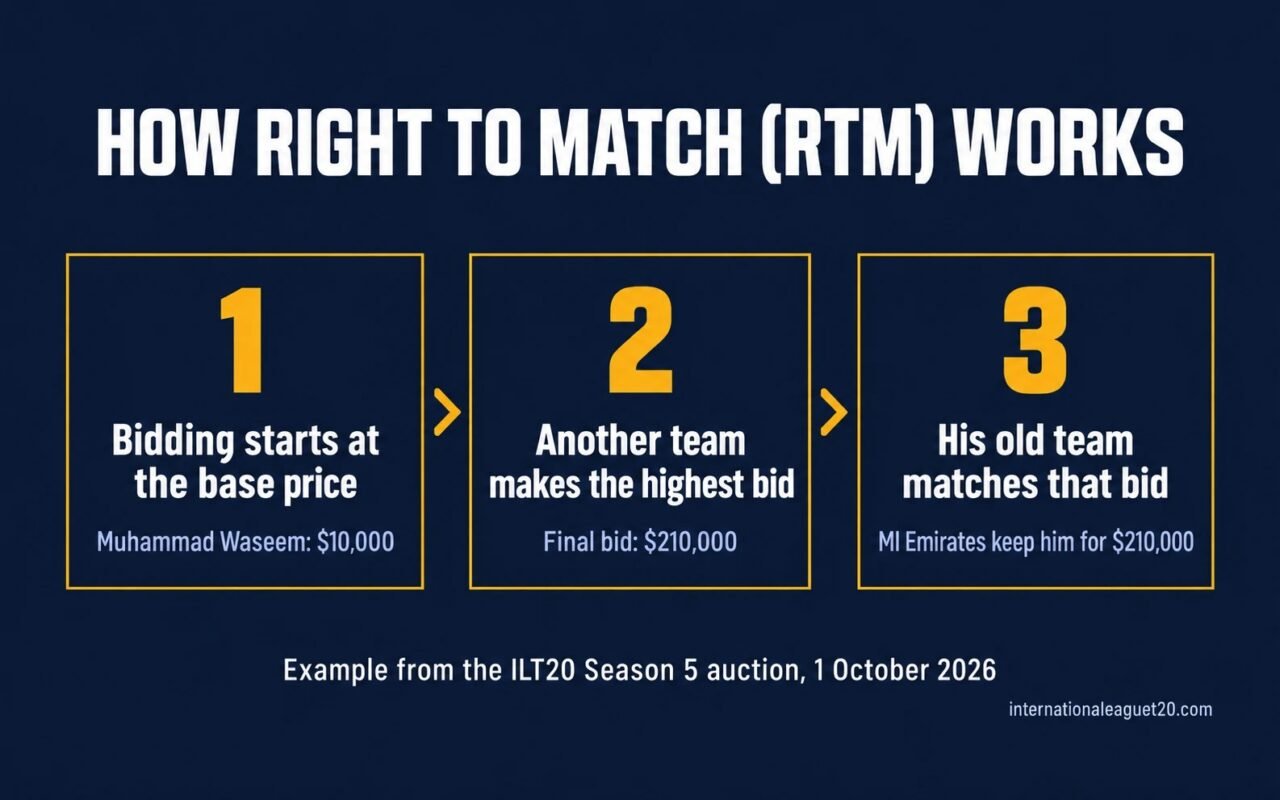
When bidding for a player ends, the auctioneer asks the player’s previous team whether it wants to use an RTM card. If it does, that team signs him for the winning bid, and the team that made the bid misses out. If it does not, the player joins the highest bidder.
Muhammad Waseem is a clear example from the Season 5 auction on 1 October 2026. Like every UAE player, he started at a base price of $10,000. Bidding climbed to $210,000, and MI Emirates used an RTM card to keep him at that price, the most ever paid for a UAE player at an ILT20 auction. Read about Waseem’s $210,000 return to MI Emirates.
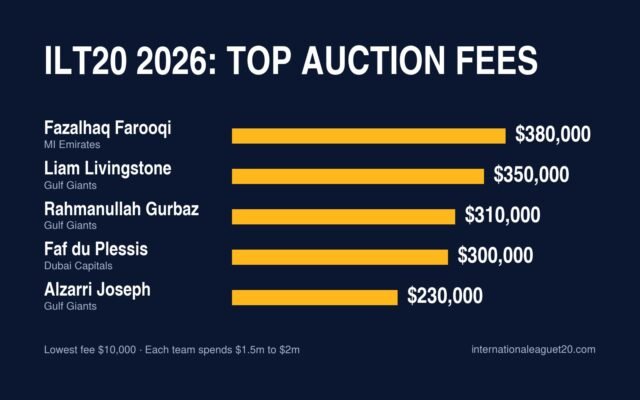
Rahmanullah Gurbaz was the biggest RTM deal. Abu Dhabi Knight Riders bid $310,000 for the Afghanistan opener, and Gulf Giants matched it to keep him. A matched price comes out of the team’s auction purse, like any other buy.
Who could be kept with RTM in 2026
According to ESPNcricinfo’s summary of the rules on auction day, each team had four RTM cards for Season 5:
- One for a Full Member player, including Afghanistan and Ireland players, who played for the team in Season 4.
- One for an Associate Member player who played for the team in Season 4.
- One for a UAE player who played for the team in Season 4 or was in its squad at the 2026 ILT20 Development Tournament.
- One for a Kuwait or Saudi Arabia player who played for the team in Season 4.
Teams did not have to use every card. Gulf Giants used theirs on Gurbaz and Kuwait’s Meet Bhavsar, while MI Emirates kept Waseem and Afghanistan spinner Allah Ghazanfar. The rules can change from one season to the next, so these four cards apply to the 2026 auction. The auction page lists every player kept with a Right to Match card.
Base price and final price
A base price is the amount at which bidding for a player starts. The final price is what the winning team pays. If no other team bids, the two are the same.
The league set three base prices for the 2026 auction: $80,000, $40,000 and $10,000. All players from the UAE, Kuwait and Saudi Arabia started at $10,000.
| Player | Base price | Final price |
|---|---|---|
| Babar Azam | $80,000 | $80,000 |
| Fazalhaq Farooqi | $80,000 | $380,000 |
| Muhammad Waseem | $10,000 | $210,000 |
| Aayan Khan | $10,000 | $95,000 |
Babar sold at his base price because Desert Vipers made the only bid. Farooqi’s price rose from $80,000 to $380,000 in a bidding contest that MI Emirates won. Aayan Khan went from $10,000 to $95,000 at Dubai Capitals, and Waseem’s bidding reached $210,000 before MI Emirates matched it.
Why auction spending and squad spending differ
Each team had $700,000 to sign players before the auction and a base auction purse of $1.3 million. Any part of the $700,000 a team did not use was added to its purse. Teams had to spend at least $1.5 million and no more than $2 million on their squads.
Here is the calculation for MI Emirates, who took the biggest purse into the auction:
| Budget step | Amount |
|---|---|
| Base auction purse | $1,300,000 |
| Unused pre-auction allowance | $90,000 |
| Purse at the auction | $1,390,000 |
| Spent before the auction ($700,000 minus $90,000) | $610,000 |
| Total squad spending | $2,000,000 |
MI Emirates spent their whole $1.39 million purse at the auction. Adding the $610,000 they committed before it gives $2 million, the most a team could spend. That is why some reports give MI Emirates’ auction spending as $2 million: that figure includes the four players they signed before the auction, Nicholas Pooran, Rashid Khan, Romario Shepherd and Sherfane Rutherford.
The $610,000 is our calculation from the purses the league published before the auction. It does not show what any single pre-signed player earns. Each team may also sign one wildcard player after the auction, for up to $250,000, which is not part of these totals.
To check every price and each team’s spending, see the ILT20 auction results.
ILT20 RTM questions
What does RTM mean in the ILT20 auction?
Right to Match. A team can keep a player from its previous squad by matching the highest bid for him.
How many RTM cards did each ILT20 team have in 2026?
Four: one each for a Full Member, Associate, UAE, and Kuwait or Saudi Arabia player who played for the team in Season 4. The UAE card could also be used on a player from the team’s 2026 Development Tournament squad.
Who was the most expensive RTM signing in 2026?
Rahmanullah Gurbaz. Gulf Giants matched Abu Dhabi Knight Riders’ $310,000 bid to keep him.
What were the base prices at the 2026 ILT20 auction?
$80,000, $40,000 and $10,000. UAE, Kuwait and Saudi Arabia players all started at $10,000.
Sources: ESPNcricinfo auction live blog, Times of India auction guide, Cricbuzz auction report.
Spotted a mistake? Email info@internationaleaguet20.com and we will correct it, noting the change at the top of the article.